Ki-67 on Your Pathology Report: What the Percentage Does and Doesn't Tell You
You are reading your pathology report and find a line that says "Ki-67: 35%." No one explained it, and the internet offers three different "normal" ranges. Here is the short version. Ki-67 is a number that estimates how many tumor cells are actively dividing. It is useful, but it is also one of the most variable numbers on the page, and it should never be read alone. Healz reads it alongside everything else in your report.
What Ki-67 actually measures
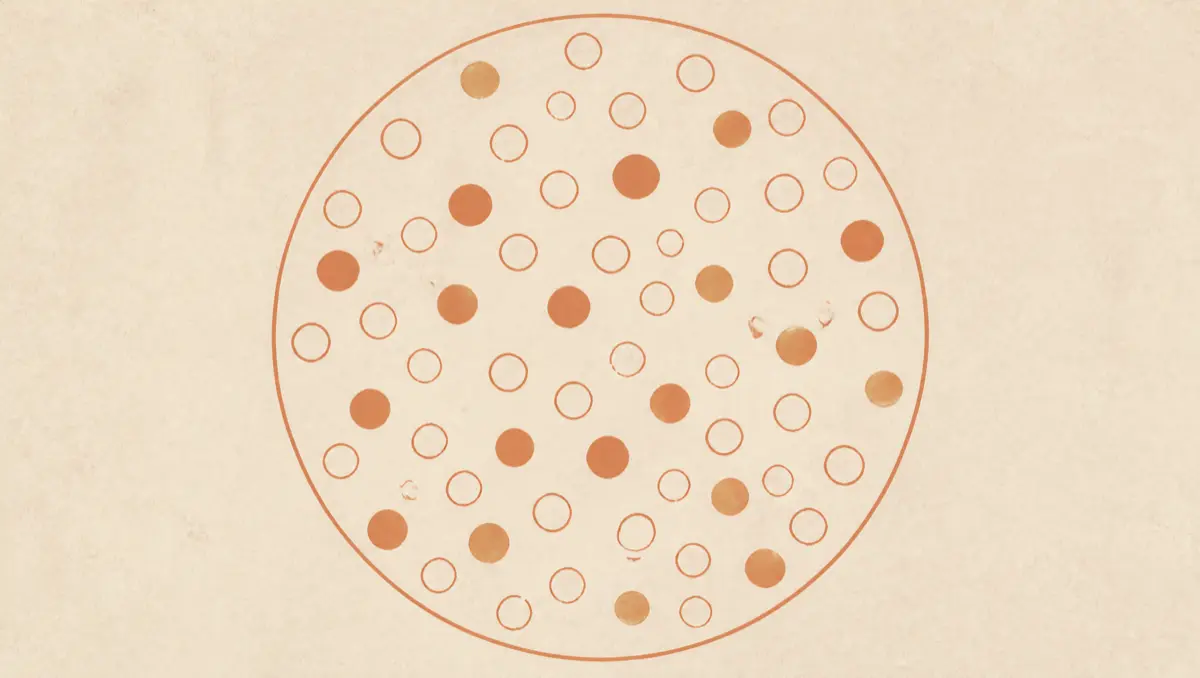
Ki-67 is a protein that appears in the nucleus of cells while they are in the process of dividing, and it is absent in resting cells. That makes it a handy marker of proliferation. A pathologist stains the tumor sample, looks under the microscope, and estimates the percentage of tumor cells that stained positive. A Ki-67 of 35% means roughly a third of the counted cells were in the cycle of division.
The name has a quirky origin. It comes from the German city of Kiel, where the antibody was discovered, and the number refers to a well position on the lab plate. Nothing clinical, just history.
Ask Healz.
One chat instead of ten apps. 1M+ rare cases checked. The root cause, not the label. Private.
How the number is counted
Ki-67 is measured by immunohistochemistry, the same type of staining used for ER, PR, and HER2. The pathologist looks at a field of tumor cells and counts the stained ones against the total. Sounds simple, but the details vary. Which area gets counted, how many cells are included, and what counts as "positive" staining can differ between labs.
Studies have shown that agreement between pathologists is reasonable at the extremes but poor in the middle range. That is the zone where many real patients fall, which is why a single reading deserves some humility. Our guide on how to read a biopsy result explains why context matters so much.
Why the cutoffs keep moving
For years, 14% was used to separate luminal A from luminal B breast cancers. In 2013, the St Gallen consensus moved the line toward 20%. The International Ki-67 Working Group later suggested that values of 5% or lower and 30% or higher are the ones reliable enough to inform prognosis in hormone receptor positive, HER2-negative disease, while results in between should not drive decisions alone, per its published recommendations. Neither ASCO nor NCCN guidelines currently tell clinicians to use Ki-67 routinely to choose treatment.
So when a friend says "mine was 18%, is that bad?", the honest answer is that it depends on the lab, the method, and everything else in the report.
Where Ki-67 still helps
Even with limits, Ki-67 earns its place in several situations.
Breast cancer. It supports grading and helps distinguish more proliferative tumors, and it can nudge a decision about chemotherapy when other information is borderline, usually next to a genomic test. In the monarchE trial of the drug abemaciclib, patients with Ki-67 of 20% or higher had a greater risk of early recurrence, though the drug helped regardless of Ki-67 level. That is why the original 2021 FDA approval required Ki-67 of 20% or higher, and why the FDA removed that requirement in March 2023. Ki-67 is also checked before and after short courses of endocrine therapy to see whether a tumor is responding. If your diagnosis is invasive ductal carcinoma, Ki-67 sits next to grade and receptor status on the same report.
Neuroendocrine tumors. Here Ki-67 is a core part of grading. Grade 1 is below 3%, grade 2 is 3 to 20%, and grade 3 is above 20%, which directly shapes treatment. Our post on carcinoid and neuroendocrine tumors covers this in more detail.
Lymphoma. Very high Ki-67 values point to aggressive disease, and the number helps pathologists tell lymphoma subtypes apart.
What a high or low number does not mean
A high Ki-67 does not mean your cancer has spread, and a low one does not mean you can skip follow-up. It describes speed of growth in one piece of tissue at one moment. Fast-growing tumors can respond very well to chemotherapy, because chemotherapy targets dividing cells. A slow-growing tumor may be less sensitive to it but often responds to hormone therapy. Neither number is good or bad on its own. It is one input.
How Healz reads Ki-67
The hard part of a Ki-67 result is that its meaning lives in context. Healz puts everything in one chat instead of ten apps. Healz is equipped with Frontier AI, so it reads your Ki-67 alongside grade, ER, PR, HER2, margins, and node findings and explains how they fit together. Healz has root-cause technology, so it checks your pattern against more than a million rare and complex cases instead of stopping at the percentage. Healz has memory, so repeat biopsies and earlier results stay linked, which makes it easy to see whether a value changed. When you want a human opinion, you can bring a board-certified doctor into the same chat for a second opinion.
Frequently asked questions
- What is a normal Ki-67 level?
There is no single normal value. In breast cancer, 20% is a commonly used dividing line, but experts say results between about 5% and 30% are unreliable on their own.
- Is a high Ki-67 always bad?
Not necessarily. It signals faster growth, which raises recurrence risk in some settings but also often means the tumor is more sensitive to chemotherapy.
- Can Ki-67 change over time?
Yes. It can differ between a core biopsy and the surgical sample, and it can drop after endocrine therapy, which is sometimes used on purpose to measure response.
- Should I ask for a Ki-67 retest?
You can ask whether your result was measured in an accredited lab with a standardized method, especially if it sits near a cutoff. Your oncologist can tell you whether it would change your plan.
A Ki-67 percentage is a clue, not a conclusion. It tells you how busy the tumor cells were on the day they were sampled, and it only makes sense next to the rest of your report. Read together, those pieces give you a plan you can understand and question.
Written by Healz Team · Filed under Health Insights